
Women in Midlife Recalibration: Not a new trend but the load is new
Jul 29, 2026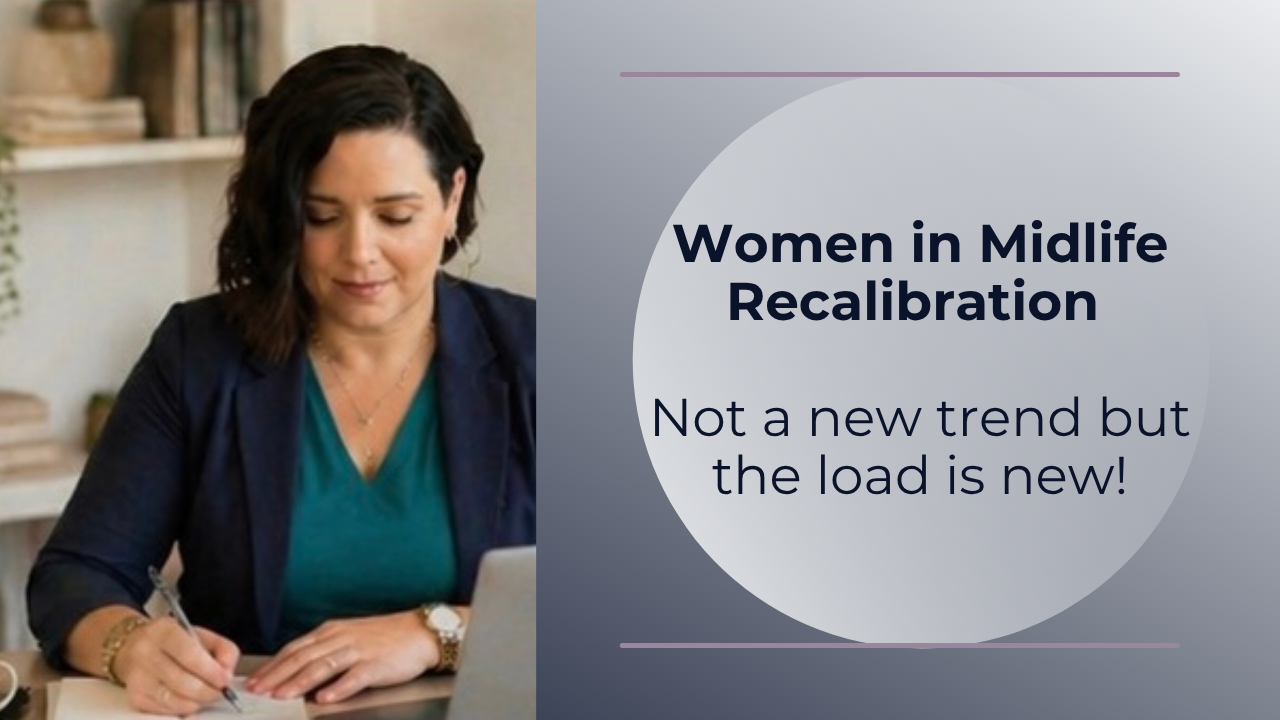
Women have been hitting this exact wall for at least sixty years. What's different this time isn't the wall — it's that we finally have a way through it that isn't a pill, a divorce, or a Substack post.
A viral essay this month told a generation of women their identity crisis has a hundred-year paper trail. It's right but it’s also wrong and it doesn’t tell women what to do about it. And those that are selling relatability on social media aren’t actually offering real so what and now what help.
It's 7:26am on a Tuesday, and millennial mum Jessica is still in bed, phone in hand, coffee going cold on the nightstand. Five minutes before the school run starts, and her insta feed hands her a carousel: “Why Are Millennial Women Having Such an Identity and Career Crisis?” A thousand likes. Hundreds of comments, most some version of this is literally me. She reads all eight slides. She feels seen, then a little unsettled, then nothing changes. She puts the phone down, gets up, does the school run.
That carousel is one of dozens moving through feeds like hers right now because of the ‘algos’— women in their late thirties and forties naming the same thing from different angles. The health retreats, corporate exits, personal branding businesses and the Substacks. The sense that the life she built doesn't fit the person currently living in it. It's validating. It's also, on its own, exactly where it leaves her: understood, and no closer to knowing what to do the next day, or worse convinced the person sharing these insights can help her.
This is what that type of content doesn't tell you, because it’s purpose isn’t to do that: this midlife moment isn't a new phenomenon. It's one of the best-documented patterns in the last hundred years of women's lives. However, what's genuinely new is this moment you're living it in — and I have to tell you that this is the part worth your time and understanding properly, because it changes what you decide to do next.
You're not imagining any of it
I’m not going to give you a vibe because I’m a strategist, so let’s start with the numbers. Australia's life satisfaction is currently at its lowest point in five years — lower than during the COVID lockdowns of 2021 — and the steepest decline is among Australians aged 35 to 44. Seventy-two percent of Australian women report burnout. Just over half report depression, and 44% report anxiety. None of that is a personal failing because you can’t schedule properly or manage or regulate your emotions. I think it’s a documented, measured shift happening to an entire cohort of women at once.
If you feel less okay than you did a few years ago, the data says you're not alone — this is measurably one of the harder stretches in years, not a personal rough patch.
There is a one hundred-year paper trail
There are a lot of online conversations about this and most of them get this right, but I don’t think they go far enough. Things are a little different today than they were for the women of previous generations. Some are calling this moment “the wall”. It’s borrowed language, but useful, because it's the same wall, over and over, just met by different generations and each time they used different tools.
In 1963, Betty Friedan published The Feminine Mystique, a study of American housewives who had done everything correctly — married well, run a home, raised children — and who described, almost identically to each other, a feeling they had no word for. Friedan called it “the problem that has no name”. Doctors of the era had their own word for it. Some called it “housewife's fatigue,” or the “housewife's syndrome,” and sent women home with a diagnosis instead of a plan.
They sent them home with Valium. Approved in the US the same year Friedan's book came out, Valium became the most prescribed drug in America by the mid-1970s, dispensed to women at roughly twice the rate of men. By the end of that decade, close to one in five American women had taken it. The Rolling Stones wrote a song about it — Mother's Little Helper, 1966 — and an entire country sang along to a track about sedating a generation of women through more or less the same feeling.
Then, in 1969, California passed the country's first no-fault divorce law. Every other state followed within about fifteen years. Between 1960 and 1980, the national divorce rate more than doubled. And the filings, then as now, have consistently come more often from wives than husbands — a Stanford study of longitudinal relationship data found women initiate close to 7 in 10 divorces in heterosexual marriages.
Let’s revisit what we’ve got here for midlife women. Grief for stability she thought she'd have, a syndrome that a doctor named, a pill to make the feeling dull enough to function through. And eventually, a door.
This is essentially the same reckoning, generation after generation, with different tools available to that decade determining what happened next.
While the pattern is old, the load today is new
So no, this isn't a story our midlife generation invented. But it would be just as wrong to conclude nothing's changed for midlife women over the last 100 years. What's different this time is the load-bearing structure underneath it.
Your grandmother hit this reckoning once, inside a somewhat stable postwar economy that mostly held its shape for decades either side of the moment she hit it. Now you’re hitting it after 9/11 in high school, graduating into the 2008 financial crisis, just finding your feet when a global pandemic reorganised the entire way we work and live, and now watching artificial intelligence reshape your entire life in real time. Four separate structural and systemic shocks across 3-4 decades, no real recovery period in between. And the modelling shows the next shock won’t be gender-neutral: the sectors expected to see the heaviest AI-driven job losses in Australia — retail, admin and support, healthcare — are the same sectors where women are the majority of the workforce.
Because we have to be real about the load, let’s layer on top that you're likely also the generation providing hands-on care to ageing parents while still raising your own kids — roughly 1.5 million Australians are currently in exactly this position, 91% of them women — and you're doing it while carrying a retirement gap your grandmother never had to reckon with in the same terms. Australian women currently retire with around $51,000 less superannuation than men, and 62% say they don't believe they'll have enough. This gap could change if employment prospects for women change due to AI.
Now, none of that shows up on a carousel slide with a thousand likes and shares on instagram. But it's the real reason this version of an old feeling is resonating so much heavier than the ones before it.
Naming it isn't the same as navigating it
This is where I think the current conversation stops…abruptly, and where I want to pick it up.
Every generation before yours hit this reckoning and eventually found one door. Sedation. Divorce. A hundred years on, you've inherited something genuinely new: your own income, name on the lease, a legal exit that doesn't require proving fault, a whole internet's worth of language for what you're feeling, and a platform to say it out loud to a thousand strangers who reply “this is literally me”.
This real progress deserves to be highlighted as progress. However, having the exit doors doesn't tell you which one is yours, or what to do once you've walked through it. What I keep watching play out, in my own community and everywhere this content lands, isn't a lack of awareness. Most women aren't confused about what they want anymore. It’s my experience that most can describe it in detail. What's missing is proof it's safe to act on it, a method for working out which move is safest and right for the specific shape of your life, rather than the shape of a some other midlife woman’s carousel.
That gap matters, because of what's actually sitting underneath the anxious feeling in the first place. Anxiety isn't caused by uncertainty. It's caused by an inability to tolerate it. And the instinct that follows — overthink it, research it, read another carousel about it — feels like preparation, but isn't. It's a nervous system trying to manufacture a feeling of certainty that was never actually on offer, and it rarely works: it just tells your brain to stay on alert, which is exactly the feeling you were trying to escape.
The fix is a strategy. Not one that is a five-year plan that snaps the second the world shifts again, but a way of reading what's actually happening around you, building a genuine set of options, and choosing between them with evidence instead of guesswork. Self-trust doesn't come from feeling calm about the unknown. It comes from proof you've navigated something difficult because you already had a plan going in.
What's actually driving it, once you strip the vibes away
In conversations with my friends and through my work with women in exactly this season, the same five things surface, in some combination:
— Grief for the thirty or forty years of relative global stability she grew up inside of, now replaced by real fear for her own future and her kids'.
— A daily life built on the assumption that the systems around her stay stable — with no backup plan for the day they don't.
— A career that no longer fits this season of her life, with no clear route to fixing it.
— Ageing parents, and no plan in place for their final chapter, because nobody in the family has actually had the conversation.
— Technology moving faster than she can keep up with safely, with most of the advice telling her to hand over her identity and her bank details to AI with zero thought given to security.
Most women are living inside two or more of these at once. That convergence — not any single one of them — is usually what tips a background unease into the full identity reckoning showing up all over your feed right now.
An old skill for a genuinely new kind of pressure
There's a navigational practice, thousands of years old, that very nearly disappeared: wayfinding. Pacific navigators crossed open ocean with no instruments, reading the shape of a swell, the position of stars, the behaviour of birds near land — adjusting course constantly, because a fixed map can't hold up over open water. That's a closer description of what this era is asking of you than any five-year plan ever will be: not a fixed route, but the skill to read what's changing around you and adjust before it lands on you.
That skill is teachable. It was always teachable — it just stopped being handed down. Fixing that gap, not adding another slogan to the ones already circulating, is what I built FuturePivots to do.
The bottom line
The internet did its job this month and it named the pattern. What it can't do, structurally, is hand you a method, because a carousel isn't built to carry one.
That's the part I spent fifteen years training in. See what's changing. Shape a real plan around it. Own what happens next. Not a slogan — the actual mechanics of getting through a reckoning that, this time, has more doors than any generation before yours has ever had, and finally, a way to choose between them on purpose.
The Pivot Collective is where I'm building that method into a place you can practise it — the scan, the strategy, and a community doing it alongside you, not just naming the feeling in the comments.
→ Learn more at learn.futurepivots.com.au
About Jacinta Robinson
Jacinta Robinson is a former national security strategist with 15 years' experience briefing at the highest levels of Australian government. She is the founder of FuturePivots, which translates strategic foresight methodology — the kind used in government and global organisations — into practical tools for homes. “I used to prep governments. Now I help households.”
Get a strategic perspective on a volatile world.
I translate high-level global & national events into actionable systems for your lifestyle, home or business. Subscribe for information on personalised and practical systems to help you navigate with more certainty.
Don't worry, your information will not be shared.
We hate SPAM. We will never sell your information, for any reason.