
The World Shifted. Nobody Told you! Why I created FuturePivots – and why you need it now
May 28, 2026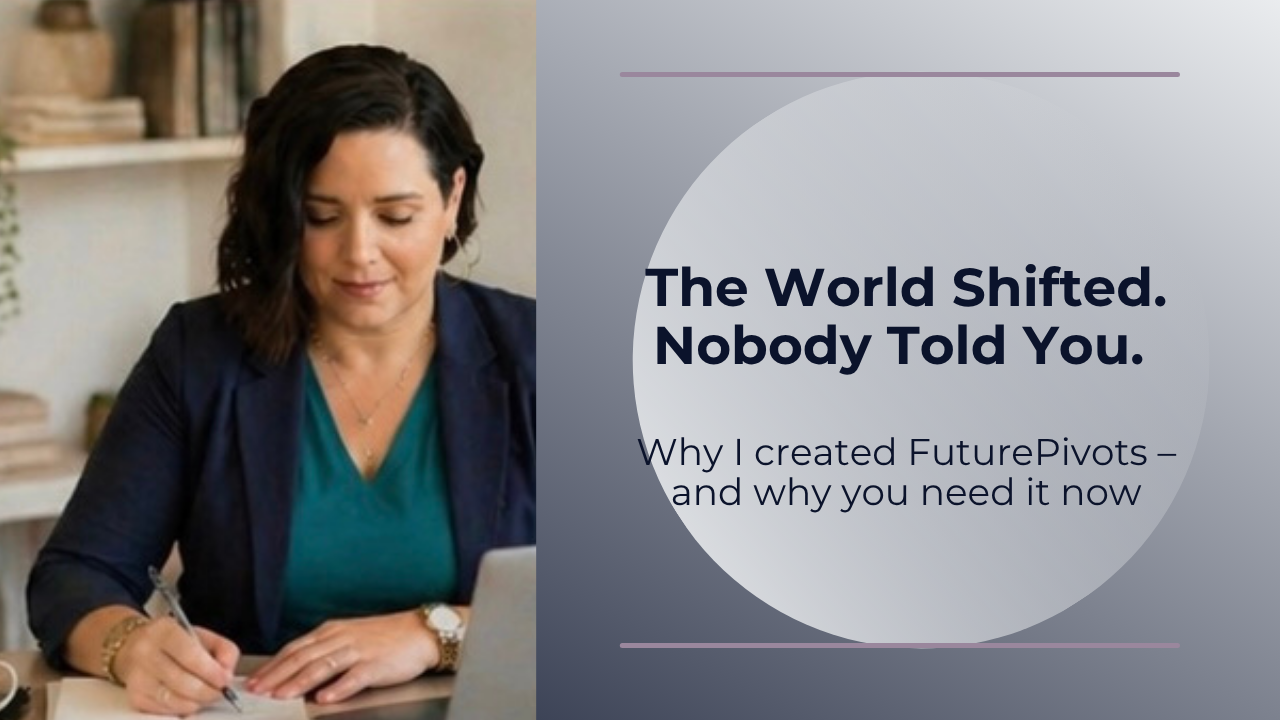
Meet Jessica.
She did everything right. Studied hard, got the degree, landed the corporate job. Bought the house when she was told to buy. Started the family. Kept her head down and trusted the formula: go to school, get a good job, get the house, have the kids — it’ll all be fine.
She’s 38 now. Her industry has been quietly hollowing out for years. The mortgage that made sense in 2019 feels like a trap in today’s interest rate environment. Childcare costs more than her first salary did. And the career ladder she was climbing? It’s been restructured out of existence.
Jessica didn’t do anything wrong. She followed the rules exactly as she was taught. The problem is that nobody told her the rules had changed.
She’s not alone. She’s a generation.
We Were Handed a Map for a World That No Longer Exists
For roughly thirty to forty years, the developed world operated in a period of unusual stability. Economies grew incrementally. Careers followed recognisable arcs. The rules of building a life — the house, the job, the plan — were largely predictable. You could plan linearly. Do A, get B. Stay the course, reap the reward.
That era is over.
The pace of technological change, geopolitical disruption, climate volatility, economic restructuring, and social transformation has crossed a threshold. We are no longer in a world of gradual shifts. We are in a world of shocks — more of them, more frequently, and hitting closer to home than ever before. Not just affecting markets or governments, but affecting your household. Your income. Your industry. Your life.
The problem is that most people are still operating with the old map. And you cannot navigate new terrain with the wrong map — no matter how hard you try.
When Complexity Becomes Unbearable, Simple Answers Feel Like Relief
There’s something important happening in our politics that doesn’t get talked about honestly enough, and it’s directly connected to everything above.
When people feel destabilised — when the future feels opaque, when the promises they were made haven’t been kept, when the complexity of the world outpaces their ability to make sense of it — they become drawn to simple narratives. Clear enemies. Clean solutions. And above all, the promise of going back. Back to the stability they remember, or think they remember. Back to a time when the rules made sense and following them actually worked.
This is why we are seeing surging support for anti-establishment movements and populist figures across the political spectrum, in almost every developed nation simultaneously. It isn’t simply anger, though there is plenty of justified anger. It is, at its core, a grief response. People are grieving a world that felt manageable. And when someone stands up and says “I can bring that world back” — it is deeply, genuinely comforting to hear.
The problem is that it isn’t true.
The stability of the past thirty to forty years was a product of specific, unrepeatable conditions — a particular alignment of globalisation, cheap energy, technological adolescence, and geopolitical order that has now fundamentally shifted. No political leader, regardless of ideology or force of will, can reassemble those conditions. The world has moved. The clock does not go backwards.
Black and white thinking is having its moment precisely because nuance is exhausting when you’re overwhelmed. When the future feels like too much to hold, certainty — even false certainty — feels like solid ground. But the people and movements selling a return to the past are not offering a strategy. They are offering a story. And in a volatile, complex world, a comforting story is one of the most dangerous things you can follow.
The answer to complexity is not simplicity. It is capability. The ability to look at an uncertain future clearly, without flinching — and to know that you have a plan.
That is what FuturePivots was built to give you.
We Were Never Taught to Think This Way
Schools don’t teach it. Financial advisors don’t teach it. Career coaches don’t teach it. What the world calls “planning” is almost always just a straight line projected forward — a budget, a five-year plan, a retirement target. It assumes tomorrow will look roughly like today.
But in a world of shocks, that’s not planning. That’s hoping.
What we actually need is the ability to map our futures — plural. To look honestly at the range of scenarios that could unfold, and to have moves ready before the shock arrives. This is real strategy. The kind that governments and sophisticated organisations have used for decades to navigate uncertainty.
Until now, it has never been translated for real people navigating real lives. And that is not an accident — it has largely been the domain of those with the resources to pay for it. Executives with advisory teams. Corporations with strategy departments. The wealthy with access to the right rooms. For everyone else — the working woman, the small business owner, the household just trying to stay ahead — this kind of thinking has simply been out of reach. Too expensive. Too opaque. Too far removed from everyday life.
That gap is exactly why I created FuturePivots.
Why Me
I spent fifteen years as a national security strategist, doing future planning and scenario mapping for governments. My job was to look at a volatile, complex world and help institutions prepare not for one future, but for many — so that when shocks came, and they always do, we weren’t scrambling. We were ready.
At some point I looked around and realised: everything I was doing for governments, everyday people desperately needed for their own lives. The tools existed. The methodology was proven. It just had never been made accessible to the people who needed it most.
So I built FuturePivots to change that.
The Specialist Problem
Here’s something worth sitting with: the world is full of brilliant specialists. Financial planners. Recruiters. Career coaches. Nutritionists. Real estate advisors. Each one is deeply skilled in their lane — and each one will give you genuinely good advice within that lane.
But your life doesn’t live in a lane. Your life is all of those things at once, tangled together, affecting each other constantly. A career shock hits your finances. A health shift changes your work capacity. An economic squeeze reshapes your housing decisions. Everything is connected — but all the specialists are handing you separate maps that don’t fit together.
What has been missing is someone who sits above all of that. Not a specialist, but a strategist. Someone who can take every dimension of your life — your career, your money, your household, your skills, your options — and pull them into a single, coherent picture.
That’s what FuturePivots teaches you to do for yourself.
In a complex, volatile world, the most important thing you can be in your own life isn’t the expert in any one area. It’s the generalist who understands how all the areas connect. The person who can see the whole board, not just one corner of it. When a shock hits, your financial plan and your career plan and your household plan need to move together — not in three separate directions at once. We teach you to build that integrated strategy, so when the moment comes, everything you have works in concert.
What a Pivot Actually is
A pivot isn’t abandoning everything you’ve built. It isn’t blowing up your career, your savings, or your identity and starting from scratch. That’s not strategy — that’s panic.
A pivot is a prepared move. It’s something you’ve already thought through, mapped out, and made ready — so that when a shock hits, you’re not scrambling to figure out your options. You already know them. You already have one foot in the door.
The FuturePivots method is built around this idea: that you can hold your current path while quietly, seamlessly preparing the pivots around it. No dramatic overhaul. No reckless bets. Just the calm confidence that comes from knowing you have a next move — and a move after that.
This is not about throwing out what you have. It’s about building the bridges before you need them.
This Was Built for You
FuturePivots is not for the executive with a team of advisors. It’s not for the corporation with a strategy department. It was built for Jessica. For the small business owner who doesn’t have a board of directors. For the working woman carrying her family’s financial future on her shoulders. For the everyday household that deserves access to the same quality of strategic thinking that has always been reserved for people with far deeper pockets.
This methodology shouldn’t cost the earth. And it shouldn’t require a postgraduate degree to understand. It should be practical, human, and built for the real texture of real people’s lives.
That’s what FuturePivots is.
Why Now
The shocks aren’t slowing down. The volatility isn’t a phase. The complexity isn’t going to simplify itself. This is the new operating environment, and the people who thrive in it won’t be the ones who work harder at the old game. They’ll be the ones who learned to play a different one.
Jessica’s generation followed every rule and still got blindsided. The answer isn’t to find better rules — and it certainly isn’t to vote for someone who promises the old ones still work. The answer is to build something the old rules never gave you: a genuine strategy for an uncertain future that is entirely, powerfully your own.
You don’t have to predict the future. You just have to stop being caught off guard by it.
That’s what we do here. Come and find out how.
Get Your Free 5 Quick Actions to Protect Your Lifestyle Flow today!
Get a strategic perspective on a volatile world.
I translate high-level global & national events into actionable systems for your lifestyle, home or business. Subscribe for information on personalised and practical systems to help you navigate with more certainty.
Don't worry, your information will not be shared.
We hate SPAM. We will never sell your information, for any reason.