
Midlife women & way finding: steering through midlife challenges & uncertainty
Aug 10, 2026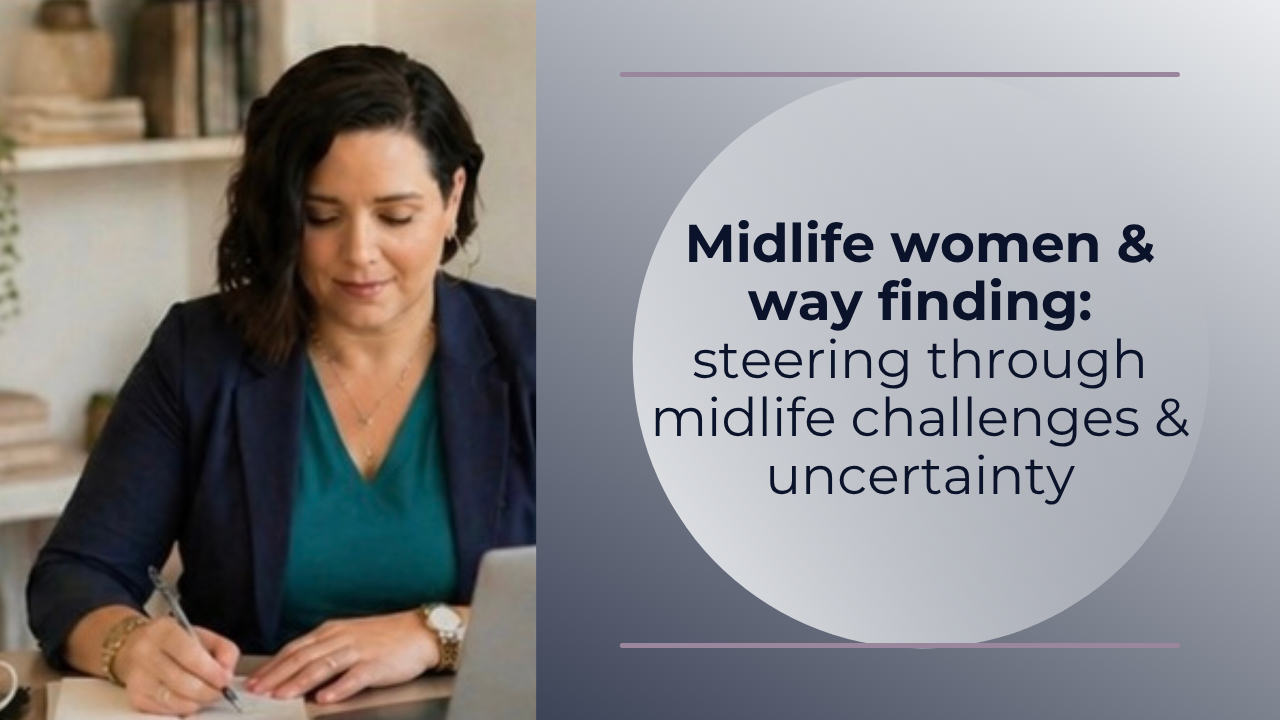
Midlife women are being told to do more inner work. I think they've done enough of it. What's missing is a way to read what's coming — and steer.
There's a thousand-year-old skill for crossing open water with no map and no instruments. It's the closest thing I've found to what this era is actually asking of women in midlife — and almost nobody is teaching it anymore.
My social media algorithms are feeding me women describing exactly how midlife feels. It’s a full spectrum - Burnt out. “Career confused.” Done with hustle culture. A Crisis or reset. There’s a lot of honesty, of lot of documenting their journey into new careers in content creation or portfolio careers. It is the most honesty and specificity in this conversation than has ever been.
But all of it stops at naming the feeling and looking inward. For at least a decade, we’ve been encouraged to do the nervous-system work. Learn to sit with the discomfort. Trust yourself. I want to be careful to say I’m not disparaging this inner work, because that work is real and I'm not dismissing it. But I think a lot of women have already done years of it — and still feel one crisis or disruption away from falling back into crisis mode. This might have been the only tool you needed through midlife when the world wasn’t going through an extraordinary reorganising or disruption wasn’t frequent.
Let me suggest that when that's where you are, the answer isn't more inner work. It instead needs to tackle the things outside of you too and a way to read what's changing in the world as well as your life, and steer through it on purpose.
There is a skill. It’s similar to one that is thousands of years old. It’s way finding.
Why the inner work alone hasn't fixed it
There might be a controversial view but if we dig into what’s happening when you feel that midlife anxiety, I think we’ve been misdiagnosing it.
Anxiety is caused by an inability to tolerate uncertainty. And when we can't tolerate it, your brain tries to regain control. It overthinks, over-plans, runs the same scenario 10 different ways at 3am. I bet this feels like preparation, I know, but it isn't. What’s happening is your nervous system trying to manufacture a feeling of certainty and it doesn't work. Instead, it just tells our brain we are not safe, stay alert. Then you end up more anxious and not less.
A lot of us are walking around with this sentence on repeat: I wasn't prepared for this or I wish I was more prepared. And for midlife women it's related to —AI, parents ageing, cost of everything, job changing, bushfires and storms. When we say this phrase enough times, across enough moments, it’s now a trauma response to uncertainty. What happens next is that you start fearing the unknown before it's even arrived, because some part of you has learned that unknown means blindsided.
Here's my strategist's take. Inner work teaches you how to feel about the unknown but it doesn't teach you what to do about it. That's the half of the equation almost nobody in this space is offering — and it's the half that settles the feeling.
The women who move through this era well aren't the ones who feel the calmest. They're the ones who already know what they're going to do.
Strategy is getting ready for what's next
I want to be clear that strategy doesn’t mean you can see exactly what's coming or about controlling the outcome. Chasing control is the trap that keeps you stuck in an overthinking loop.
What strategy does give you is a diversity of options and it means you’re not reacting to every single thing as it occurs. It costs you nothing to create and instead saves you from standing there empty-handed saying I wish I'd been more prepared. Strategy gives you your first couple of moves, backups and options.
I'm not talking about mapping every possible future because that's not strategy. Rather a handful of scenarios that are genuinely likely for your midlife and having a plan for those.
This is also where self-trust really comes from. We've been taught to build it by feeling calm. I don't think that's quite right. At least for me, self-trust is built through proof. If you get through something because you already had a plan in place then that becomes evidence and not a feeling, that you can handle what's next.
What wayfinders knew and why its relevant to our midlife right now
Way finding is the thousand-year-old skill I keep coming back to for navigating uncertainty in midlife. It clicked for me after watching Moana with my son during the school holidays.
Traditional Pacific navigators crossed thousands of kilometres of open ocean with no instruments. No compass, no charts. Not unlike what we're all doing right now, in a world reorganising in real time.
They read the shape of a swell that had travelled from a storm days away and hundreds of kilometres out — long before the storm itself was visible. That's reading the signs of change before they arrive to disrupt your everyday life. They tracked star paths as they rose and set, shifting with the season like a moving map across the sky, not a fixed route. That's the equivalent to our flexible midlife strategy, built to adjust.
This skill was taught, practised, passed down as generational literacy. And then, in places like Hawaii, it very nearly disappeared completely, as colonisation and disrupted trade broke the chain between the people who knew it and the people who needed to learn it. It survived only where voyaging never fully stopped, and where someone made the deliberate choice to teach it forward again.
This is the parallel I’m making and the skills needed for today’s reorganising world with creating a midlife strategy. Your capacity to read what's coming hasn't disappeared but it has been interrupted by stability, convenience, a few decades where it felt like you didn't need it. The skill isn't gone. It just stopped being handed down.
A fixed map can't survive open ocean. What this era asks of you isn't a five-year plan that snaps the moment the world shifts — it's the skill to read the signals around you and adjust as you go.
I use this on my own life
I'll be honest about where this concept got tested. Earlier this year, something happened at work that made me pause and think about my job, lifestyle, money and purpose. It was the first time in my life I'd had to face real uncertainty about my own future, and as someone with high-functioning anxiety and a lifelong overachiever streak. I needed structure and something that accounted for multiple options as well as produced actual backups. I have responsibilities. A child I want to be present for. Ageing parents I want to be able to care for.
So I used the tools I'd used professionally as a strategist and futurist on my own life. I ran the scan across every part of it, and what showed up was three or four options with backups built in across the next twelve months. The scenario I chose gave me four months of real runway which has been enough to build this business with intention instead of desperation, with my health prioritised, and do work that aligns with my values.
I’m convinced this isn’t just a me problem. When I ran the scan, every one of the pressures I hear from other midlife women showed up in my own life. AI reshaping the job market. A oil and gas crisis on the other side of the world proving how fragile our supply chains really are. My own career no longer fitting the season of life. My parents getting older and more fragile, with a hundred conversations about their final chapter we haven’t had. And underneath all of it, that grief for how steady things used to feel, and the fear about what comes next.
By March, I'd made my decision. I didn't want to react to these disruptions so I pivoted toward the most important work of my life. And I still think of what I do as national security. Just a different kind, at a different level: more directly helping people prepare to reduce anxiety, overwhelm and the psychological effects that follow.
The five pressures in midlife
These five pressures are unique to the women in midlife. In my work with women in this season, the same five surface over and over, usually two or three at once: grief for the stability we grew up with; a daily life built on systems we have assumed will stay stable, with no backups; a career that no longer fits; ageing parents with no plan in place; and technology moving faster than we can keep up with and safely.
What matters here is that none of these five is a personal shortcoming. Every one of them is a signal you can learn to read before it impacts you and your family. That's the purpose of wayfinding.
This isn't coaching or doomsday prepping
Two quick things about what I do and what my system is, because it gets mistaken for both.
What I do isn't the traditional life coaching with passion-finding or manifesting. Instead, I teach you to work outside-in. This is real strategy, the kind used by governments, institutions and companies, packaged for you for your own life. And there's no doomsday prepping in it either. No bunkers or worst-case fantasies. That language has poisoned the words resilience and preparedness for last twenty years and driven people to not prepare at all. Preparing for reality leads to the opposite of fear. It gives you the calm that comes from having already looked at a few different future scenarios relevant to you and made a plan for each of them.
My mission is to help women move through what's piling up in midlife — career shifts, ageing parents, digital precarity, and disruption to everyday stability — with a strategy built on options and backups. So instead of reacting to everything unravelling in midlife, you've got a direction to steer through this uncertainty.
My Podcast title isn’t just that. See it, Shape it, Own it is the method:
— See it: anticipate what's going to change your future, before it happens to you.
— Shape it: use that knowledge to design your scenarios, and build your backups and options.
— Own it: pivot when the change comes, without the stress, the anxiety, or the sense that it's the next crisis.
The midlife recalibration needs a method
The wayfinders crossed the ocean because they'd been taught to read the water, and they trusted what they'd been taught, not because they were fearless (although I’m sure that there was a little bit of that). What I want for you is both a calmer relationship with the unknown AND the actual skill to read the signs of change and move ahead of disruption.
If any part of this felt like I was describing your last twelve months, there are two ways in. Register for my free workshop, where I walk you through the method for mapping the signals of change in and around your life. Or get on the waitlist for the Pivot Collective, where the scan, the strategy and a community doing this alongside you all come together properly.
You are not lost or in a crisis or confused. You were just never handed this method. That's what I'm here to fix — one pivot at a time.
I have a whole podcast episode dedicated to way finding and midlife women. It's a bonus episode and you can listen here.
→ Learn more at learn.futurepivots.com.au
About Jacinta Robinson
Jacinta Robinson is a former national security analyst and strategist with 15 years' experience briefing at the highest levels of Australian government. She is the founder of FuturePivots, which translates strategic foresight methodology — the kind used in government and global organisations — into practical tools for homes. “I used to prep governments. Now I help households.”
Get a strategic perspective on a volatile world.
I translate high-level global & national events into actionable systems for your lifestyle, home or business. Subscribe for information on personalised and practical systems to help you navigate with more certainty.
Don't worry, your information will not be shared.
We hate SPAM. We will never sell your information, for any reason.