Foresight is finally having its moment. I just hope we don’t waste it.
Jul 28, 2026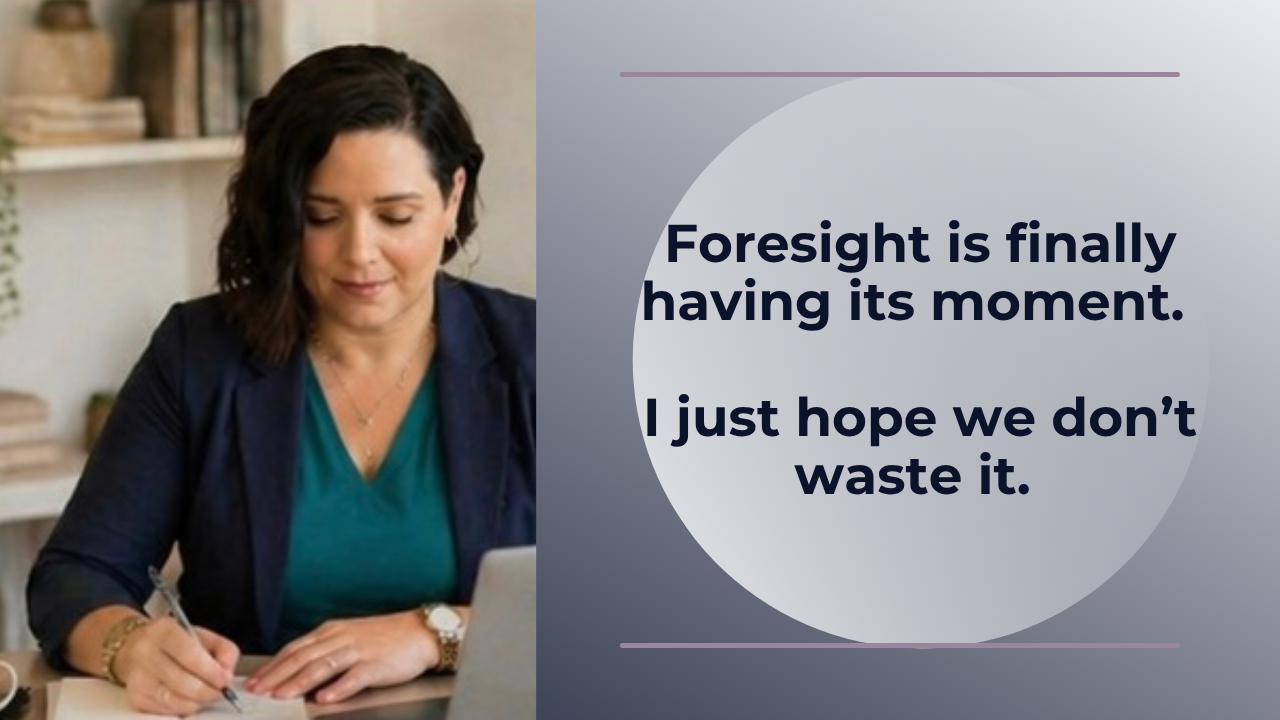
Over the past few months I've being seeing something I've hoped for a long time would happen. People are talking about the future, and I mean properly talking about it in a structured way. Strategic foresight is turning up in LinkedIn posts and podcast feeds. More people are running courses on it. Consultants are folding it into what they offer. Organisations are (slowly) waking up to the fact that the world they're planning for is reorganising and they plans they built a year ago, aren’t going to cut it.
After years working in this space, this should be all good news and don’t get me wrong, a lot of it is.
But I have some serious worry sitting right alongside the excitement, and because I can’t help myself, I'd rather name it than pretend it isn't there. Foresight is fast becoming something people admire rather than something they use properly. Those are two very different things. The gap between these is where real value is either delivered or vanishes entirely.
One of the things I've always loved about this work is that it makes you look past what's right in front of you. It asks you to sit in and with uncertainty which is really uncomfortable but it’s where the progress happens. It pokes at and brings to light your assumptions, stretches how far ahead you're willing to look, and lets you hold a few possible futures in your head at once rather than planning everything on a single likelihood about what's on the horizon or around the corner.
But this is only the beginning, even though it’s a valuable part, it’s where most people stop or can’t get past. A lot of people started treating the insight from this exercise as the outcome. But it isn't and that’s where my concern comes from.
Knowing that AI is reshaping work is not a strategy. Knowing that your parents' generation is ageing into a decade of care is also not a strategy. Neither knowing that the cost of everything keeps increasing. Those are observations from the foresight exercises and will give you genuinely good scenarios about what to anticipate. Useful scenarios. But until someone turns them into decisions, priorities, options and next steps, nothing in your life or your work changes.
And to be completely frank, that's exactly where I see the conversations getting stuck when people talk about the value or work they’re doing in strategic foresight and futures.
More and more people are learning a handful of tools, finishing a course, discovering scenario planning for the first time, and turning straight around to sell it as something they can offer in coaching, consultancy and business support. We all start somewhere — I did too. But understanding a method and being able to steer a real person through real uncertainty are different skills, and right now, it’s my view this is the difference that matters most when it's your future on the table.
You can argue with me on this, but I think the tools are the easy part. The harder part is turning complexity into something you can use right away and get real results. It's staying clear and steady when there's no clean answer. It's helping you make a call while the future refuses to cooperate. It's knowing when a framework helps you and when it's just there to look clever. And it's understanding that you probably don't care about foresight at all but you care about what it lets you do.
I spent years doing this work in rooms where the decisions carried real weight — where a wrong call had a cost, and a beautiful scan that ended in a shrug was worth nothing. Nobody I briefed ever asked for the impressive part. They wanted the answer to one question: so what do we do now? That question is the whole job of foresight thinking but a lot of practitioners don’t finish it with a strategic planning outcome. I also think it’s why, even though its such a powerful tool, it doesn’t resonate with the everyday person, but absolutely should be taught in schools as part of a toolkit to navigate what is going to be a volatile and challenges few decades ahead.
It's also why I spend so little time, in my own business, talking about the methods.
You're not lying awake wanting someone to teach you horizon scanning. You’re too busy trying to hold together a career that's stopped feeling secure or not aligned to your season of life. And for some, you're supporting ageing parents while you're still raising your own kids. You're mind is occasionally wondering what AI means for the work you do and you’re trying to make good financial decisions while the economy and policy keep changing. You're carrying a dozen uncertainties at once and wondering how anyone's meant to make solid choices when nothing will stablise.
What is needed right now, in this moment in history and for many women in midlife, is someone who can help you make sense of what's shifting and build you a strategy with options in it.
That's where foresight and futures work earns its keep — as a way of helping an ordinary woman get ready for an extraordinary amount of uncertainty, not as an academic discipline or a drawer full of clever tools.
Which is why a lot of what I do probably doesn't look like foresight at all. Behind the scenes I'm scanning trends, connecting signals, thinking in systems, mapping more than one version of what's ahead. You don't need to see any of that. You need the translation. You need someone to sit across from you and say: here's what this means for you. Here's where the risk sits. Here's the opening you hadn't spotted and the options worth building now, while you've still got time. And finally, here's how you stop reacting every time life piles another thing on. The strategy I hand you is built the same way I used to build in national security strategic advice for the government — stripped right back so it works for one person, their household or small to medium business, instead of the national security environment.
I wished we talked about this part more in our profession. Not the methods or the jargon. The translation!! This is where foresight becomes strategy, where a complex idea becomes a decision you can act on, where uncertainty becomes something you can steer through instead of simply endure.
The future isn't going to get more certain. If anything it's heading the other way. That's the whole reason I hope this work doesn't harden into another buzzword or another gallery of impressive-looking models, infographics or workshops. I hope it gets more human. More practical. Easier to reach.
The future becomes useful when someone can turn all that complexity into choices that make life run smoother and there is better quality occurring. That's the real work — and right now, I think it's the work that matters most.
If you'd rather have that kind of thinking in your corner than another framework to file away, that's what Wayfinders is for — a free place to start. Get in contact, and I’ll send you a link to join!
Get a strategic perspective on a volatile world.
I translate high-level global & national events into actionable systems for your lifestyle, home or business. Subscribe for information on personalised and practical systems to help you navigate with more certainty.
Don't worry, your information will not be shared.
We hate SPAM. We will never sell your information, for any reason.